 Posted by
 Reading time: 10 minutes

Microsoft Quantum Lab Delft
Last week I was very lucky to be able to visit the Microsoft Quantum lab at the TU Delft, together with my colleagues of the Amsterdam Innovation Hub. With all the activity around AI, it’s also amazing to see all the progress that is being made in the world of quantum computing.
As you might expect, the taking of photos was not allowed. So I’ve got AI to help me out with this image 😊.

I was really introduced in the world of quantum and the way organizations can start using these technologies (together with AI and High Performance Computing or HPC) in the next years. This really struck me; Quantum computing is making such strides and is no longer a “Star Trek” kind of evolution. It’s here and companies are already looking at use cases.
Please note that this is a complex subject and I won’t cover all concepts in this blog article. For more information, please go to https://quantum.microsoft.com
We also touched on the cybersecurity side of this equation. Breaking encryption is one “use case” that most people probably will bring up when we talk about quantum. And sometimes even with the reference to either the German Enigma or Lorenz encryption devices from the second World War.
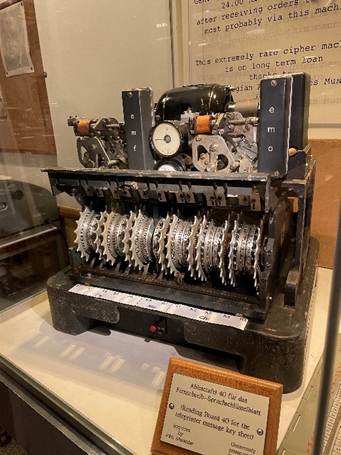
Which is a fun exercise, but futile. As you might expect, even the simplest computer and AI model can “break” these encryption techniques easily. And quantum would not make that big of a difference.
However, quantum computing becomes interesting for modern cryptography. And especially when we look at the commonly used asymmetrical encryption RSA and ECC; RSA/ECC could be broken in days or hours on large quantum machines | Some estimates suggest <1 week for RSA-2048 with enough qubits.
Encryption?
Perhaps it’s best to first look at asymmetrical and symmetrical encryption. These concepts are used to make data unreadable, unless you can decrypt it. Symmetrical encryption uses one key for both encrypting and decrypting. When you both have the key, you can both read the data. It’s very fast and can handle large amounts of data. This form is normally used to encrypt files or disks (like Microsoft Purview Information Protection), databases and VPNs (some examples).
Asymmetrical encryption uses two keys instead of one (and no, this is not Double Key encryption!). These two keys form a keypair: the public key and the private key. When the private key is not compromised, the encryption is save. This type of encryption is used all over the place: securing websites with HTTPS/TLS, digital signatures, secure email and authentication and (again) Microsoft Purview Information Protection.
Microsoft Purview Information Protection [MPIP] uses a hybrid form of encryption; It uses both symmetric and asymmetric encryption. Symmetric encryption is used to encrypt the content. Symmetric encryption is still “safe” from quantum computing. Asymmetric encryption is also used, to encrypt the symmetric key and the rights management policy. In effect, a very secure concept.

But in the quantum world we are entering, things are about to change.
So why is encryption an issue when considering quantum? The answer is: mathematics. Asymmetrical encryption is build on hard to solve math problems like factoring huge numbers (for one). These would normally take forever to solve…..with current day computing power. A quantum computer can solve these in much less time. As for symmetric encryption: this does not reply on these math problems. If the key is large enough, encryption is safe. When there is a problem, just make the key larger.
So it’s time to look at quantum.
Quantum
For many decades, our traditional encryption methods have protected sensitive data from cybercriminals and nation-state attackers. Even when data was stolen or otherwise left the organization, the encryption would protect that data. This makes perfect sense as our digital world runs on trust. Every online payment, encrypted email, banking transaction, healthcare record, and corporate secret depends on cryptography.
While quantum computing promises breakthroughs in medicine, logistics, climate modeling, and artificial intelligence, it also introduces one of the greatest cybersecurity challenges of the century. The same computational power that can solve previously impossible scientific problems could also crack many of today’s encryption standards.
Like MPIP, many of today’s cybersecurity infrastructures rely heavily on public-key (asymmetric) cryptography algorithms such as RSA and elliptic curve cryptography (ECC).
These algorithms are considered secure because classical computers would require thousands—or even millions—of years to solve the mathematical problems behind them. However, quantum computers change the equation entirely.

Using algorithms such as Shor’s Algorithm, a sufficiently powerful quantum computer could theoretically break widely used encryption systems in hours or even minutes. And this creates a serious problem. And don’t think that this problem will arise when such a computer is finally here. Bad actors are already preparing for this (and so should we…).
Harvest Now, Decrypt Later
When encrypted data is stolen or otherwise leaves the organization at this moment, we can be relatively sure that this data stays protected. For someone to open a document that is protected using Microsoft Purview Information Protection, you will need to have access to an account that is listed in the protection settings of the sensitivity label. And when these settings also require the accounts to be checked when opening the document (the “offline availability” setting), we add another layer of protection.
The combination of symmetric and asymmetric encryption, using the strongest standards available, ensures this data protection. And no computer can break this……yet…..But don’t be lulled into a false sense of security, thinking your encrypted data is save when it is lost or stolen. Cybercriminals and hostile actors may be are already collecting encrypted data today with the intention of decrypting it once scalable quantum computers become available in the future. This is known as harvest now, decrypt later.
This means that our sensitive information with long-term value—government intelligence, healthcare records, intellectual property, financial data, and legal archives—could already be at risk. And this is especially the case in Financial Services | Healthcare | Government and Defense | Telecommunications and Cloud Computing.
So, what can Microsoft do and what can you do?
Quantum-Safe cryptography
There are several aspects to this and for this blog I want to focus on quantum-safe cryptography, also called post-quantum cryptography (PQC). This refers to encryption methods designed to resist attacks from both classical and quantum computers.
The global cybersecurity community, including the National Institute of Standards and Technology (NIST), has been working to standardize next-generation algorithms that can withstand quantum attacks. You can find their work here: Post-Quantum Cryptography | CSRC. Some of these leading quantum-resistant standards include ML-KEM | ML-DSA | SLH-DSA | FN-DSA. These algorithms are designed around mathematical problems believed to be resistant to quantum computation. Mark the word “believed” – as none of us can really predict the future, right?
From a Microsoft perspective, we are investing heavily into quantum by building advanced quantum computers and integrating quantum into Azure. The Delft Quantum Lab is just one example of this. And also protecting against the new quantum threats. This initiative is called the Quantum Safe Program (QSP).


When I visited Microsoft Ignite in 2019 (!!!) in Orlando, Satya Nadella already spoke about Azure Quantum. Not surprising, as Microsoft was already working on post-quantum as early as 2014. In 2025 the Majorana 1 quantum processor was introduced. And in the time in between, we’ve been working on the QSP strategy and timeline.
And as you can see in the timeline below, PQC will become available in Microsoft Products and services, like MPIP.

Crypto-agility architecture
In addition to making Microsoft quantum safe and promoting global research, standards and solutions for quantum-safe, one of the key priorities for PQC is the concept of crypto-agility. This concept is becoming one of the most important concepts in future cybersecurity, because no single algorithm can guarantee permanent protection. Like I said earlier – no one can predict the future….
At this moment, many systems are rigid and difficult to upgrade. The concept of crypto-agility should offer the ability to rapidly switch cryptographic algorithms without rebuilding entire systems. SymCrypt is part of the solutions for this.
SymCrypt: Microsoft’s Cryptographic Foundation
As of November 2025 Windows 11 and Windows Server 2025 fully support PQC. This means that these operating systems use quantum-resistant cryptographic algorithms. These were provisioned using the Microsoft SymCrypt cryptographic library. SymCrypt is the core cryptographic library powering Microsoft 365 | Windows | Microsoft Azure.
The coming years, we can expect that the global infrastructure will be migrated (I envision a hybrid state btw), while maintaining compatibility and performance. And just to be sure, Microsoft is not working alone on this. We collaborate with major international organizations including NIST | IETF | ISO | ETSI and the Open Compute Project to establish standards for quantum-safe cryptography and ensure interoperability across global digital infrastructure.
Quantum Computing and MPIP
For this part of the blog I do have to be a bit careful, as some information is still under NDA or is even not fully available at this moment. I don’t have any information on the effects of migration to PQC on current encrypted data or any steps required by organizations. I do have some thought and will share these at the end of this blog. From a roadmap perspective, I can share that:
– Early adoption of quantum-safe capabilities is targeted around 2029
– Broad transition across Microsoft products and services is targeted by 2033
– Microsoft aims to complete migration before many government 2035 deadlines
Microsoft expects a phased transition using hybrid cryptography where both classical and post-quantum algorithms operate simultaneously during migration. I would expect that the current RSA and ECC algorithms will be migrated to PQC without any effects on the functionality of Microsoft Purview services.
What can I do?
Is there something we as an organization can do in the meantime, as we don’t have any influence on the Microsoft Purview platform and services? Yes, you can. And these steps should not come as any surprise, to be fair.
Assuming that you are already protecting your most sensitive data with labels and the current encryption, of course. Which, by the way and as you know, is an ability that spans across Microsoft 365, Microsoft Azure, Fabric and non-Microsoft environments. But I digress….
In the Netherlands we have a saying that goes like this.
“Voorkomen is beter dan genezen”
Which translates to something like “Better safe than sorry” or “An ounce of prevention is worth a pound of cure.”. Prevent that data harvest of encrypted data….
Infrastructure
I hope these items are irrelevant, because these have already been addressed some time ago. But here goes 🙂
– Remove ALL legacy authentication
– Update ALL unsupported Office clients
– Eliminate EVERY old TLS version
– Use Microsoft 365 and Azure cloud-native services
Which also means that you will need to do an inventory of your current infrastructure, code, data and all other aspects where encryption might play a role.
Zero Trust
The Zero Trust framework (never trust, always verify) is still very relevant today, but sometimes only implemented on a limited scale. But please take care in:
- setting up strong identity protection, life cycle management (even for AI Agents!) and going password-less
- using (risk based) conditional access rules
- proper (mobile) device management and protections
- enabling network based and/or edge protections
- enabling cloud app protections
Data loss prevention and Insider Risk Management
Microsoft Purview Data Loss Prevention is still one of the greatest solutions to employ directly. Even when data is encrypted using sensitivity labels, it still makes sense to prevent that data from egressing the organization (by emails, Teams messages, AI, USB drives, and more) if it doesn’t need to do so.
Insider Risk Management is the go-to solution to detect and prevent major data harvest scenario’s by blocking access to the data directly and informing your Security Operations Center.
Retain/remove
Minimize the data within your organization. I know, we all love to retain a lot of our data. But this does not make sense. Minimize the amount of all data, including the highly sensitive category. If data is obsolete, has become irrelevant or should no longer be in your possession (as per GDPR for example), remove this from the organization. Bad actors still love to harvest those client data from 2015. Especially when these contain personally identifiable information or PII. So focus on the information that must remain confidential 5+, 10+ or even 25+ years. Like legal records | intellectual property and healthcare records.
If you are not doing this already, start using Microsoft Purview retention policies (or labels) to automatic remove the information or via a disposition process. Because, if the data no longer exists, it cannot be decrypted later.
Customer keys
Microsoft 365 and Microsoft Purview have offered the function of a customer key for some time. This function allows organizations to configure the so-called Data Encryption Policies or DEPs using a customer managed key.
The DEPs will start using this key instead of the Microsoft standard keys. The customer keys are stored in Azure Key Vault or even in Hardware Security Modules (HSMs). Using this concept you have better key control, if needed. It also helps you align with the PQC best practice to easily change cryptographic standards over time: the organization controls the root key life cycle and updates keys and policies independent from Microsoft.
Double Key Encryption
Be very careful with this! MPIP allows you to use an encryption process called Double Key Encryption. When a document (!) is labeled using a sensitivity label, the content is encrypted using the Microsoft controlled key and a customer-controlled key. Both are required for decryption.

Although this presents the highest level of encryption, it has very specific draw-backs. Search, AI, Microsoft 365 Copilot, co-authoring and some other Microsoft 365 features will break when using this function. Also, the organization will have to manage a local KPI. If there is a problem with the customer-controlled key, Microsoft will not be able to help.
Sources
Like I said earlier – I cannot cover all there is to know about quantum, PQC and QSP. For one, I’m still blown away with the math and other sciences behind it. But I hope this article did explain some of the important concepts. Here are some links to read more:
Microsoft Quantum Lab Safe Program
https://news.microsoft.com/europe/2019/02/21/microsofts-new-quantum-computing-lab-in-delft-opens-its-doors-to-a-world-of-possibilities/
Microsoft Quantum Cryptography
https://quantum.microsoft.com/en-us/our-story/quantum-cryptography-overview
Microsoft Azure Quantum
https://azure.microsoft.com/en-us/solutions/quantum-computing/
Microsoft Purview Information Protection
https://learn.microsoft.com/en-us/purview/information-protection
https://learn.microsoft.com/en-us/purview/double-key-encryption
https://learn.microsoft.com/en-us/purview/customer-key-overview
Azure Key Vault
https://learn.microsoft.com/en-us/azure/key-vault/general/overview